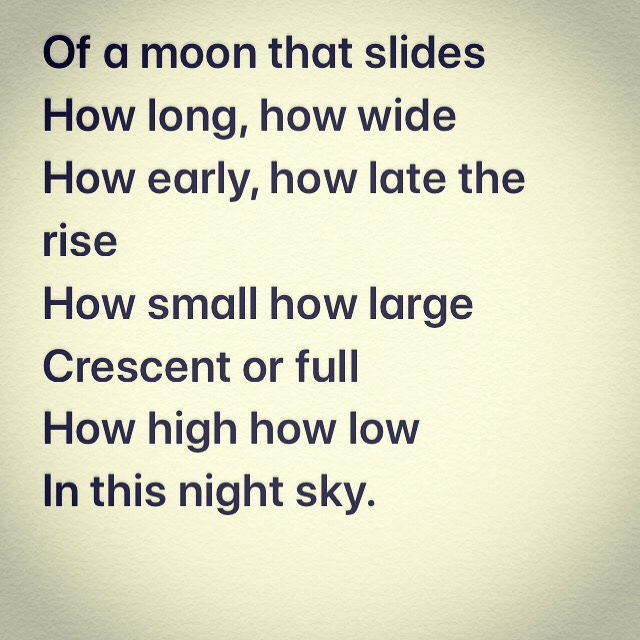
Rush Hot Now (rough draft)

Found from an old site, part of a 30 poems in 30 days challenge.  This is from ten years ago.

Just a few snippets from that time ten years ago, since I am submitting a revised/ edited full version for publication and don’t want to have this considered published.

#13 /List poemSummer Things I Forgot

i did not rush, hot, now.
i forgot how.

i forgot poetry would end
coffee at midnight, phone calls
in the middle of the night
would all end

i did not rush, hot, now.
i forgot how.

Selected Publications


pexels-photo-997721 Publications, Laura Lee

Some of my poems, short stories, and nonfiction articles are included online and in print books and magazines published in the UK, Greece, India, New Zealand, and the United States. Many thanks to the staff at these publications. 

“Devastation,” a poem, August 2019, in Headline Poetry.

“Havishammed +1,” a poem, August 2019, online and in print edition available through amazon.com and at High Shelf Press.

“Where You Are Not,” a poem, June 2019, Esthetic Apostle, here.

“Swamp Pearls,” a poem, May 2019, in Prometheus Dreaming, here.

“Not Sleep,” a poem, in Cagibi: A Literary Space, April 2019, here: Cagibi.

“The Professor and the Gravel,” a poem, 2019, at Wingless Dreamer.

“Saltwater Faces,” an ekphrastic poem inspired by paintings at the Art Institute of Chicago, High Shelf Press, 2018, here.

“Click,” “The Night is our First Language,” and “They Left the Bed,” poetry published in The Poetic Bond VIII print issue, December 2018. Available at Poetic Bond VIII.

“Moving Gravel” a short story at Crack the Spine – Themed Anthology Submissions, “Routine”, print edition, 2018. Available at Crack the Spine Anthology.

“Walk with Child,” a poem, in Snapdragon Journal, September 2018, “Here and Gone” theme, here.

Coffin Bell Journal,2018, “Herstory,” a poem, October 2018. here.

Spillwords Press, “Stopped,” a poem, 2018, here. 

Tuck Magazine, June 2018, “Teach to Kill” http://tuckmagazine.com/2018/06/06/poetry-1528/.

Tuck Magazine,  May 2018, “Refuge,” http://tuckmagazine.com/2018/05/29/poetry-1511/.

 Southernmost Point Guest House (UK), poetry.

Journal of Modern Poetry 21 (Volume 21), “Hell, No,” a poem at JOMP Volume 21 Dear Mr. President.

Journal of Modern Poetry 20 (Volume 20), “Moonlit Awakening,” JOMP Volume 20 Poetry Writer’s Guide to the Galaxy.

Journal of Modern Poetry 18 (Volume 18), The Official Poets Guide to Peace, two poems: “Open” and “After Poetry Class.” 2015. Purchase here.

Journal of Modern Poetry 17 (Volume 17), JOMP Volume 17. 

Cram Volume 12: “White Board Clown,” 2011. Chicago Poetry Press 2011.

Magazine (New Zealand) , Raewyn Alexander, Publisher, nonfiction and poetry.  Raewyn Alexander NZ.

Fiction in: http://staxtes.com/2003/ “Between the Sunlight and the Skipping” in English Wednesdays

Poetry in: https://poetsagainstthewar.org/ archives.

Illinois English Bulletin, a publication of the National Council of Teachers of English, nonfiction article about teaching in an alternative education program.

 Poetry in Marginalia, Elmhurst, IL.

Poetry as Gift

   This has been a touching day. A former colleague reached out and asked me to join/ read her blog dedicated to her brother’s memory. I waited a while, then read…about a missing brother, found dead after 62 days, and what that meant to her family.

A nightmare… missing, dead… found dead by my friend. Her mom doesn’t know anyone saw the body… in that condition… so much more I don’t wish to say.

I don’t know why she reached out to me, but social media let her find me.

I remember my friend L as a kind, witty, hardworking science teacher. I was the literacy coach in the building, often a hated person. But L was kind and worked with me, let me into her classroom. And then I got transferred to another school and we lost touch until recently.

After  read her blog, I was stunned and also very aware of what a privilege it was to be trusted with this knowledge.  How should I respectfully reply?

I asked L if I could write a poem about sisters and brothers for her, and that while I don’t know her situation exactly, I am old enough to have known much grief. L had a broken heart, and I know about broken hearts.

I thought of the many years I looked for my brother in different ways, estranged due to our father’s many violences. All the longing to find him over the many years. The late nights, the silent mornings. The bird songs that found me still awake.

I gave L the poem, knowing there is nothing good I could say that would make any of this okay. Brothers don’t go missing then get found… like that… but of course they do. In real life, horrible things happen.

L liked the poem and posted it on her blog so her family members could read it as well.

I am very happy that literacy could help me reach her, that reading led her to find me, that poetry helped me reach her. It’s a small thing, but I hope positive.

And this is a small tale of how literacy can help lives and how literacy can help us reach each other, heart to heart, mind to mind. And the special place of poetry to be personal and universal at the same time.

Nine Month Sentence ROUGH DRAFT. To edit. Revise.

ROUGH DRAFT. to edit. Revise.

Just a few snippets from that time ten years ago, since I am submitting a revised/ edited full version for publication and don’t want to have this considered published.

The Nine Month Sentence

Stunned. Nine months of

little sun, closed streaked windows to follow.

We had not

used our summer well.

We had not slept

under the June blue sky,

toes curled in fresh green.


…We might

flee with them.

What do You Call Your Father?

42694360_10155800587148499_7360350429420453888_n FROM THE WRITINGS SNIPPETS RANDOM AS I THINK OF THEM FOLDER

 CNF STARTER:

I Never Called for Him

Being older, I sometimes find myself in the “remember when” conversations with family, friends, colleagues.  And sometimes those conversations turned to our childhoods and what did we do, or watch, or dress like, or listen to, or call…

Or call. Yes.  Lolo what did you call your father?

Indeed. What did I call my father? I could not remember calling him anything to his face.

‘What did you call yours?” I might ask, trying to avoid the question.

Daddy, if I wanted something.

Sir, Yes, Sir.

And then she laughed, the kind of laughter that meant love, trust, fond memories.

Mitter, another friend said.

Da, another said.

Papa.

Pop.

Dad.

DAD!

HEY!

Old man.

OG.

Pops.

Lots of laughter, lots of smiles.

Me, oh I don’t remember.

Me?  I don’t remember calling my father anything.  I don’t remember calling him at all.

I never called him on the telephone if I could help it.  I never called him anything to his face.

But writing was different. In writing in those spiral angst filled journals, I called him my father.

With my siblings it was He or Him.  What kind of mood is He in?  Shhh… Him one of us might whisper, pointing with our chin to another room where He was. Or sometimes just among ourselves we would call him by his initials, LW, and later The Weird One. If we said That Bastard, we knew we meant our father.   Or if we said that mother fucking cocksucker son of a bitch we knew we meant our father.

Perhaps it was our way of identifying our father while keeping him at a distance.

I did not share these family secret of what we called my father at any party or any gathering ever.

But if I were honest, I believe this–I never called for him.


Learning from Garbage Day

bicycle pexels    You need help, was all he said.

I had just come home from visiting a dear friend, and was making three trips from the curb to the car to the house–taking in emptied garbage cans, my purse, etc. I think I was limping a bit, leftover injury that’s so much better now, but still a limp at times.

He was a boy of 11-13, just riding his cool stingray bike around the block, around, around, around. I noticed him circling, looking bored. He seemed to be new to the neighborhood. Maybe he was checking out the middle school nearby.

After my second trip, a wheel on one of the garbage cans fell off.

You need help, he said, loud enough for me to hear him. No yelling. No gestures that would raise alarm. He stayed on his bike. A kid.

You need help.

Excuse me?

You need help?

No, thanks, thanks a lot though. You getting ready to go back to school.

Yeah, he said, sounding a bit sad.

And he rode off.

In another world, I would have said thank you , what’s your name, here’s $5 to carry this stuff in for me.

In this world, I wish I could have told him, someone taught you manners, and that’s great. But in this world, we don’t talk to women we don’t know for it scares them and we women tend to mistrust many males, even boys of 12-13.

And as a teacher, I would be very reluctant to accept help from ANY youngster not known–and I mean parents knowing ME.

If I see him again when I’m with the Big Guy, I will say hello and thank him for the offer.

But in this sanitized and isolated suburbia, we pay for help we cannot do ourselves. There is no community. None. We are advised to socialize out back, not in front. Nothing in front of the houses. No bikes, no lawn furniture.

Make it look like no one lives here but trees and shrubs and garbage cans.

I think I’m right that this was a boy who was taught to help the elderly.

Lesson learned, we are no longer than country.

We are the country of no guns allowed signs on schools, churches, etc.

We are the country of ever smaller nuclear families.

We are the country of cars and garages and where simple courtesy can be seen as dangerous. By children or adults.

It made me glad somehow that he asked, nonetheless. I salute your parents for teaching you manners. I hope I thanked you with a sincere smile; I didn’t have the heart to tell this middle-schooler that we just are not friendly to strangers.

I did look for this boy, but I never saw him again.  I hope he is still willing to help out older folks, and hope his heart is still so good.


Poetry or Fiction: Genre Decisions/ Rough Draft

Can any topic be used for a poem? A narrative of a father drunk vomiting… agreeing to drive daughter to work during a winter storm–how can that be in a poem? I’m feeling the story wants to be a poem–or am I being influenced too much by Hayden’s “Those Winter Sundays?”

Because I have been reading poetry and keep coming back to  “what did I know” This father is not a farmer, but a father who wasn’t always drunk and sometimes tried to help his daughter get to work so she could save money for college.  (When he wasn’t waiting for her paycheck to “give it home,” if he was drunk on payday—before direct deposits.)

Because no, maybe fiction would be better. The father heaving, vomiting between telling Lo he will, he should drive her to work in a storm, not to walk in the storm. Lo wondering… can she trust Da to drive her?

Fun to explore the decision of what genre would be best for a narrative. Interesting to learn what these characters insist on–poetry, my usual genre, or fiction?

img_1235-1 

Da Girl

Da, girl says
Are you sure you can drive?
Five minutes, he says.

Tap-water instant
Coffee effort Not doing it.

Can you boil water, Lo,
can you?

Five minutes more, he says,
Don’t walk, I hear
The storm.

Da, she whispers,
I’ll lost my job,
Searching the sideways blizzard.


***And a link to Hayden’s poem: https://www.poetryfoundation.org/poems/46461/those-winter-sundays

Little Sister-Rough Draft

img_1235-1

Just something I found on an old flash drive.  Will edit, revise, see where it goes.

Just a few snippets from that time ten years ago, since I am submitting a revised/ edited full version for publication and don’t want to have this considered published.

Little sister
you are not alone
sometimes I am
in your dreams
purring
a pink cat who speaks.

And sometimes
I am at the top of the stairs
thrusting
limbs forward
as a shield.


Little sister, sometimes
I am in between the lines of
words from decades ago
straight to your mirror.


img_1235-1

“Devastation” Published at Headline Poetry Today

Happy to have a poem published today (“Devastation”) at Headline Poetry.

The history of the poem arises from when I taught ELL years ago.  It was around 2002.  I taught with a colleague who was a refugee from Sarajevo. She survived the siege–and the stories she told still haunt me.

saravejo siege

Thanks to the editors at Headline Poetry.


Photo credit: https://creativecommons.org/licenses/by/2.0/

The Destructive Age of Urban Warfare; or, How to Kill a City and How to Protect It

John Spencer | March 28, 2019